
33rd International Input-Output Association Conference
15th Edition of the International School of I-O Analysis
4th - 9th July 2027, Hong Kong, China
|
|
 |

Why Hong Kong?
Hong Kong is a compact, English-speaking, and highly connected city. For an IIOA conference it offers a research university with a strong input-output group, a dedicated MTR station under the venue, and straightforward travel from East Asia, Europe, and the Americas.
English-speaking academic environment. English is an official language of Hong Kong, the main teaching language at HKU, and the working language of government, business, and the legal system. Airport staff, hotels, and most visitor services operate in English.
A leading university. HKU ranks among the world’s top universities. The Department of Geography and affiliated groups have made HKU a recognised centre for human geography, urban planning, global supply-chain and environmental-economic research.
International connectivity. Hong Kong International Airport is served by about 140 airlines flying to more than 220 destinations. Direct long-haul flights link Hong Kong to London, New York, Los Angeles, Paris, Frankfurt, Sydney, and major cities across Asia. Most delegates can reach the city in a single flight.
A safe and navigable city. Hong Kong ranks among the world’s safest large cities. Public transport is extensive, air-conditioned, and bilingual. The conference campus, hotels, and harbour-front districts sit on a small, walkable part of Hong Kong Island.
East and West in one city. As a Special Administrative Region of China with a common-law system and deep ties to both the Anglophone world and mainland China, Hong Kong is a natural meeting point for global input-output work on trade, production networks, and sustainability. Macau, Shenzhen, Guangzhou, and the wider Guangdong–Hong Kong–Macao Greater Bay Area are close enough for a short extension after the conference.
Gateway to Asia. A Hong Kong conference helps the Association engage the growing input-output community in East and Southeast Asia — including the Chinese mainland, Japan, Korea, Southeast Asia, and Oceania — regions whose supply-chain change, ecological transition, and development paths are central to current I-O research.
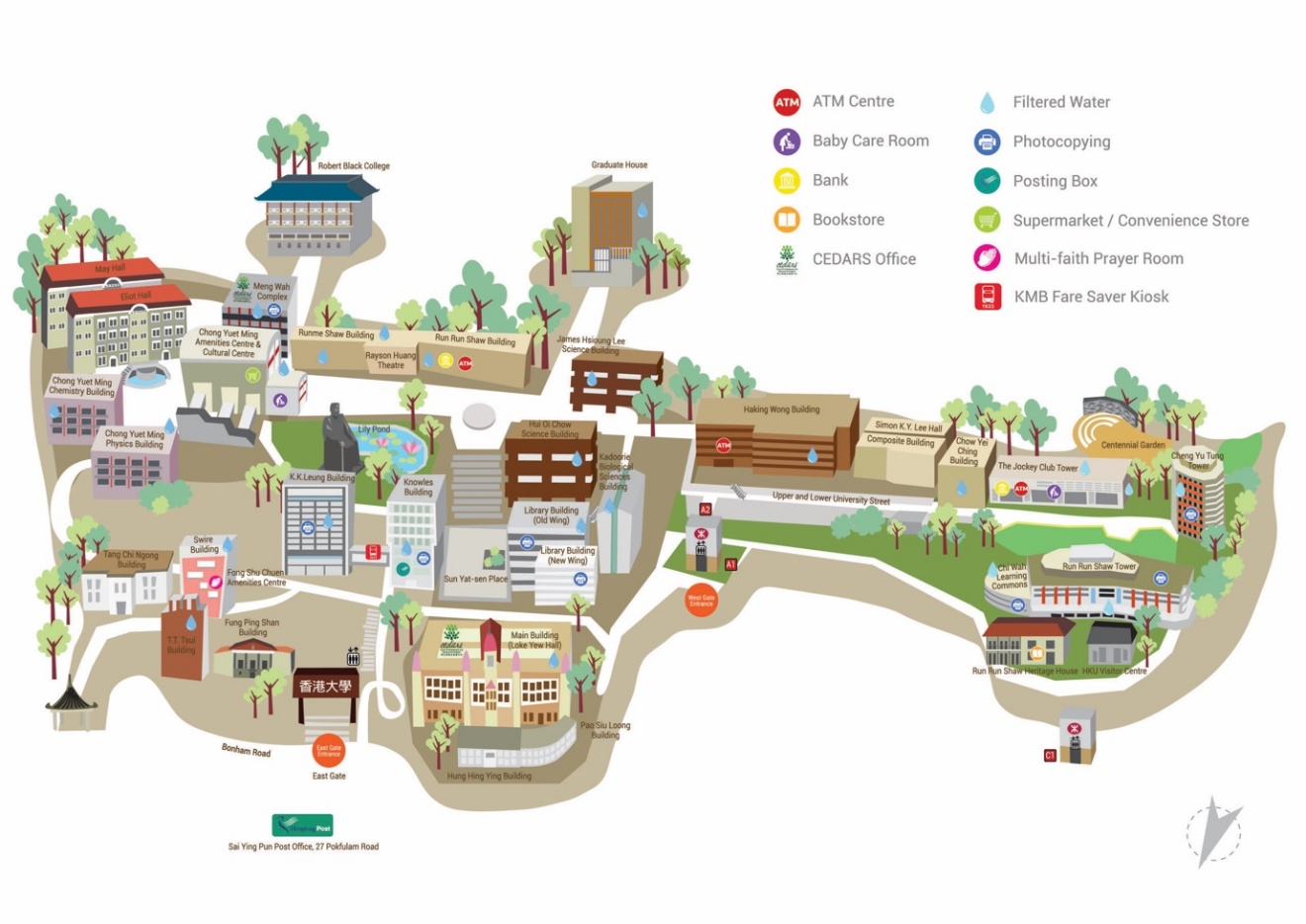
Map of HKU. The Centennial Campus and HKU Station sit on the western side of the main campus. Source: HKU IIOA 2027 bid proposal media pack.